Know how you work best.
The Inspire Profiler builds a picture of how you think and work in 15–20 minutes, then turns it into practical adjustments you can take into a conversation. You stay in control of every word that gets shared.
- Screening and support, never a diagnosis
- Nothing shared unless you choose
- Delete everything with one button
- Built to WCAG 2.2 AA
Read the transcriptHide the transcript
Every mind works differently. Some of us think in pictures, some in patterns, some in bursts of brilliant ideas. But most workplaces were built for just one way of thinking.
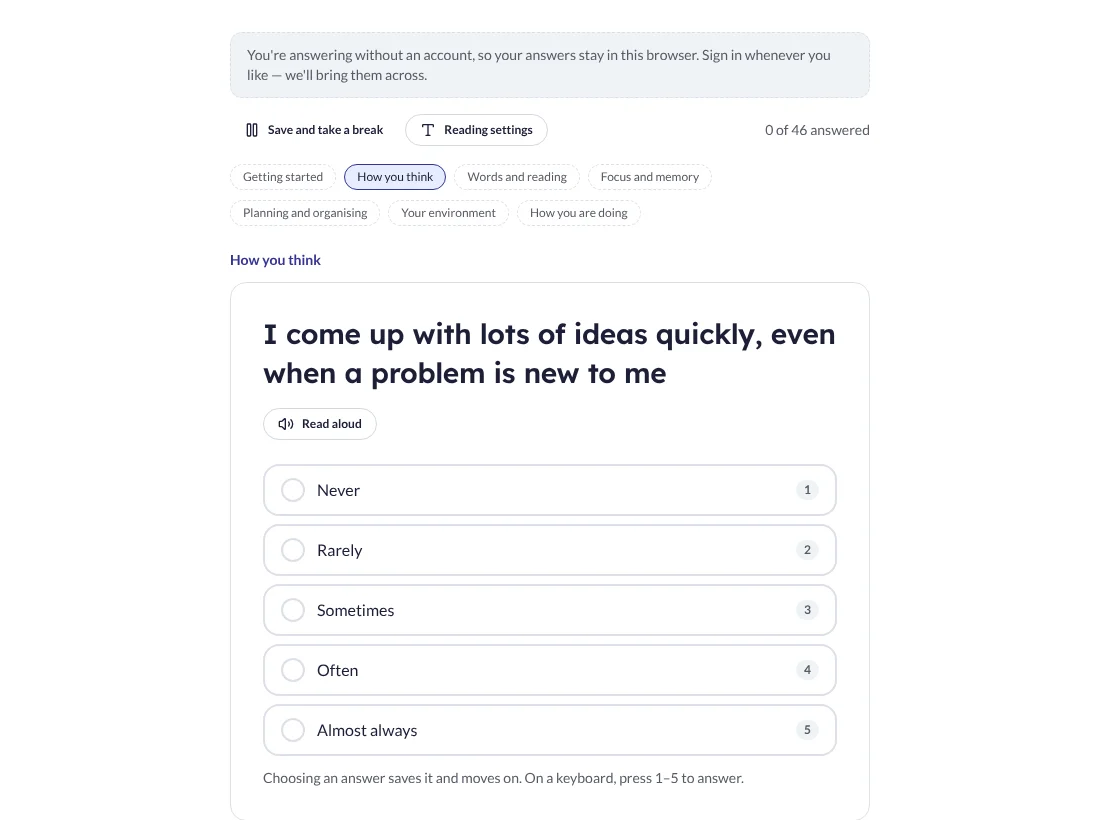
The Inspire Profiler, from Inspired Minds, helps you understand how you work best. Calm questions, one at a time. Hear them read aloud, make the text bigger, and pause whenever you like.
In fifteen to twenty minutes, you'll see your spiky profile: eight ways of working, with your peaks named as strengths — not scores to fix.
Then turn it into real support: a plain-English report, an adjustment plan, and a work passport you control. Nothing reaches your employer unless you choose.
And when you want more, our specialists are here. Start your free profile today. Let's inspire great minds together.
Watch it first
Under a minute on what you'll answer, what you'll see, and what stays private.
How it works
Answer at your own pace
15–20 minutes of short questions, one per screen. No timers, no trick questions. Stop whenever you like — your answers save as you go, on any device.
See your spiky profile
Eight ways of working, shown as peaks and steadier areas. Peaks are named as strengths, not scores to fix — and the profile adapts, asking more only where it matters for you.
Choose what you share
You get a plain-English report and an adjustment plan you can edit. Nothing reaches your manager or HR unless you switch it on, line by line — and you can switch it off again.
- Ideas
- Problems
- Talking
- Focus
- Reading
- Memory
- Planning
- Sensory
An example spiky profile — eight ways of working, one colour each.
Private by default.
Your answers belong to you
Your employer never sees individual results — only anonymous patterns, and only once at least 10 people have finished. That's enforced in the database, not just the interface.
You share on your terms
Your work passport is a short, practical summary. You pick each line, edit the wording, and choose whether your manager, HR or nobody sees it. Every time a manager opens what you've shared, it's logged.
For employers
Roughly one in seven people are neurodivergent. The profiler helps your organisation act on that — without ever asking anyone to disclose a label.
See the employer view- Participation you can see
- Invite your people with one link and a one-time email sign-in. Track invited, started and completed counts — never individuals.
- Insight without exposure
- See where support is needed most and which adjustments people accept, once at least 10 profiles are complete.
- Adjustments that happen
- Most adjustments cost nothing. Employees confirm when one is in place, so you see follow-through, not just intentions.
Start free, go further
Take it as far as you want. The profile and everything it produces are free; the people behind it are there when you want them.
Free, no account
Your profile
Answer the questions and see your spiky profile straight away.
Free, with an account
Report, plan and passport
Keep your answers, get your plain-English report and plan, and share what you choose.
Paid, with Inspired Minds
Coaching and screening
Talk it through with a specialist, or go further with a neurodiversity screening.
Screening from £325 · coaching from £110
See prices
Questions people ask
Is this a diagnosis?
No. Inspire Profiler is a screening and support tool. It helps you understand how you work and ask for practical support. If you'd like a formal assessment, your GP, occupational health, or an educational psychologist are the usual routes — your report includes signposting.
Who can see my results?
Only you. Your answers, profile, report and plan sit against your account, and nobody at your employer can open them. The only thing anyone else can ever see is a passport line you have explicitly switched on for them — and you can switch it off again at any time.
What does my employer get?
Anonymous patterns only — participation counts and organisation-wide averages, and those appear only once at least 10 people have finished, so nobody can be identified by elimination. Individual completion status is never shown.
How long does it take?
Most people finish in 15–20 minutes. There's no timer and no need to do it in one sitting — every answer is saved instantly, and you can pick up on another device.
What if reading long text is hard work for me?
Every question has a read-aloud button, and every page has reading settings: larger text, wider line spacing, a dyslexia-friendly typeface, and a dark theme. They follow you around the app.
Can I change my mind later?
Always. Reword or unshare any passport line instantly, retake the questions as your work changes, and delete everything — answers, profile, report, plan and passport — with one button in Settings.
This is a screening and support tool, not a diagnosis. It can help you understand how you work and ask for support. If you would like a formal assessment, your GP, occupational health, or an educational psychologist are the usual routes.